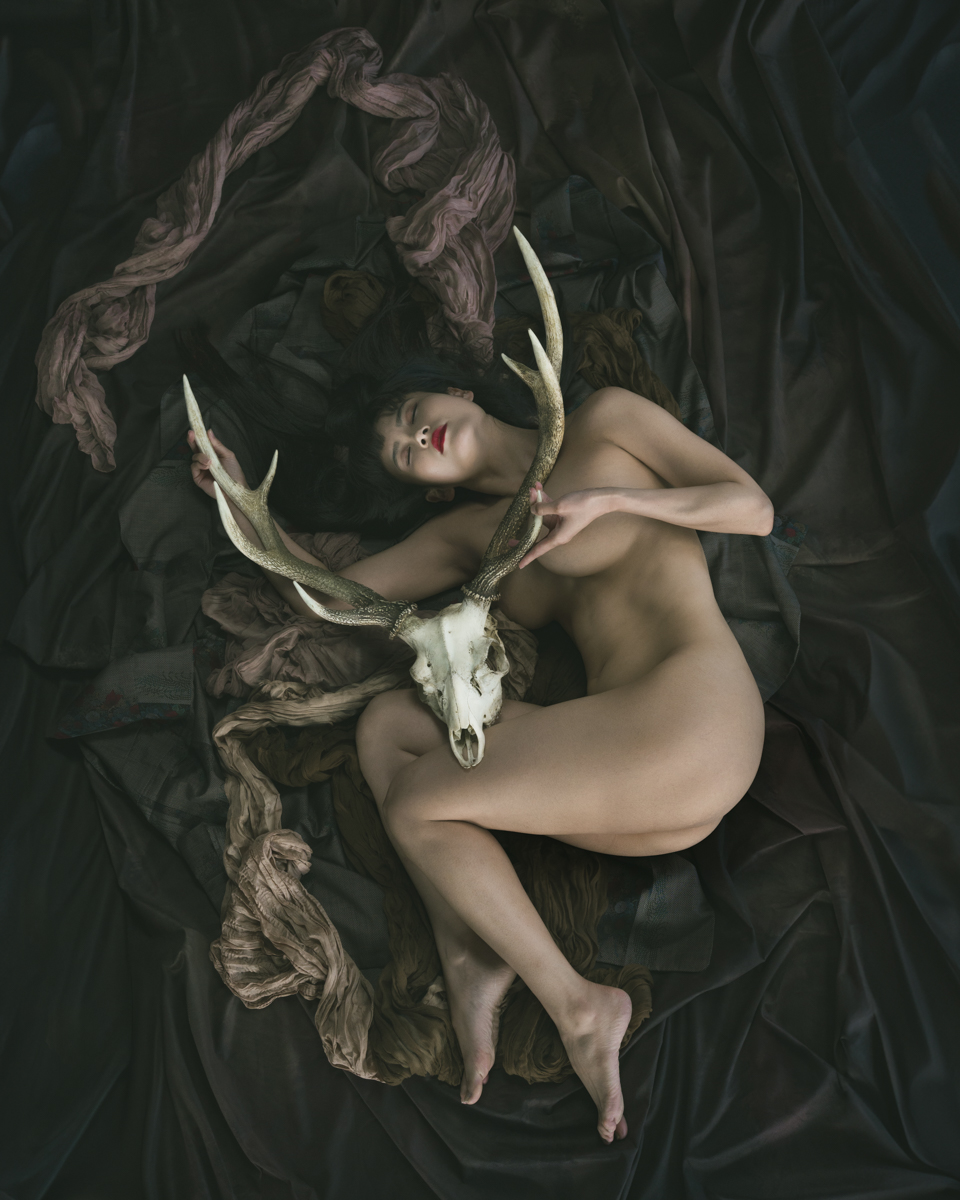
Fine Art nominee
Sumi Noma
The Circulating Body (Single)
DESCRIPTION
The Circulating Body reflects a Japanese understanding that all beings exist within nature’s continuous flow.
This image was inspired by the skull of a stag found in the forest after returning naturally to the earth. The once-powerful animal had completed its life; its flesh became soil, its bone remained as quiet testimony.
In Shinto thought, life and death are not separate realms. Everything—human, animal, soil, forest—shares the same sacred ground. What falls returns. What returns nourishes.
The antlers speak of strength once released into the world. The female body, breathing and present, echoes the earth itself—receiving, holding, and giving back.
Bone and skin are not opposites. They belong to the same cycle.
A body returns to soil.
Soil becomes forest.
Forest sustains life again.
Nothing disappears.
It changes form and continues.
AUTHOR
Sumi Noma (born in Ishikawa, Japan) is a lens-based artist whose work explores life as a continuous, circulating process rather than a linear progression. Her practice examines relationships between the human body, organic remains, and material surfaces, focusing on quiet states of coexistence that precede narrative or symbolic meaning.
Before establishing her current artistic practice, Noma worked under her legal name, Azumi Fukuoka, as a journalist and editorial photographer for major Japanese newspapers. Beginning in 2006, she photographed subjects such as natural disasters, landscapes, and portraits. Following the 2016 Kumamoto earthquakes, she documented the lives of affected communities, with more than 100 photographs and articles published nationally.
Between 2014 and 2019, her work was exhibited in Japan and the United States, including the joint exhibition Drift – Lives & Landscapes in Fukuoka and the ICP One-Year Certificate Program Student Exhibition in New York. After returning to Japan in 2020, her practice shifted toward intimate, body-centered work exploring femininity, vulnerability, and cycles of transformation.
Her recent body of work, The Circulating Body, presents the human body not as an isolated subject, but as part of a shared system in which life, matter, and presence continuously transform and return.
←
back to gallery