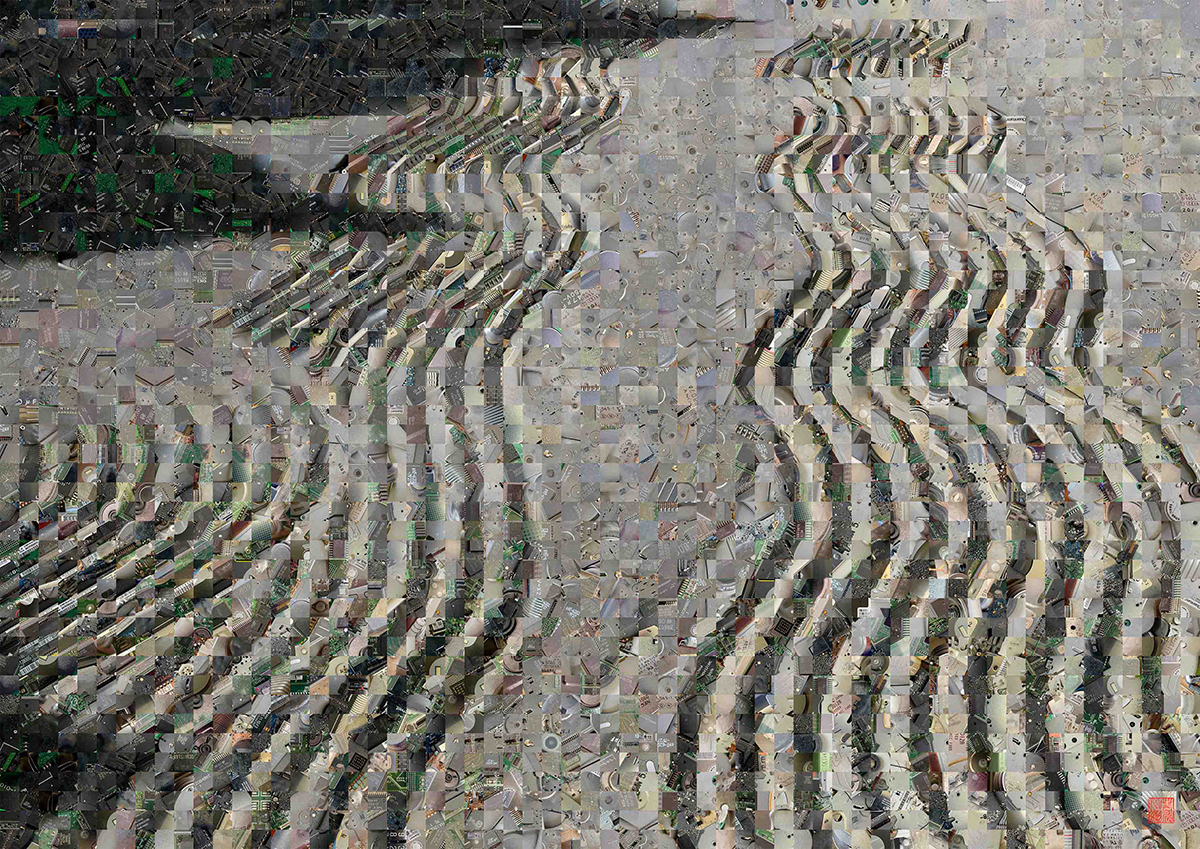
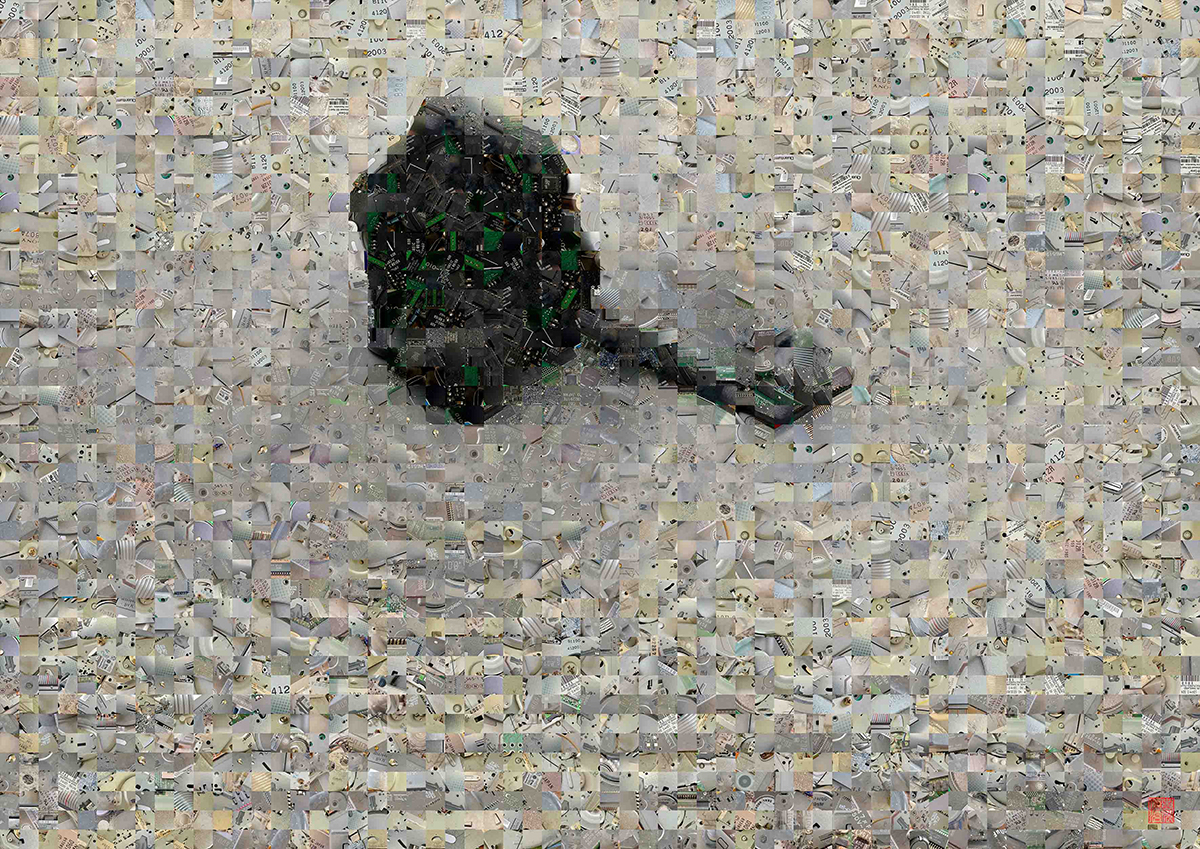
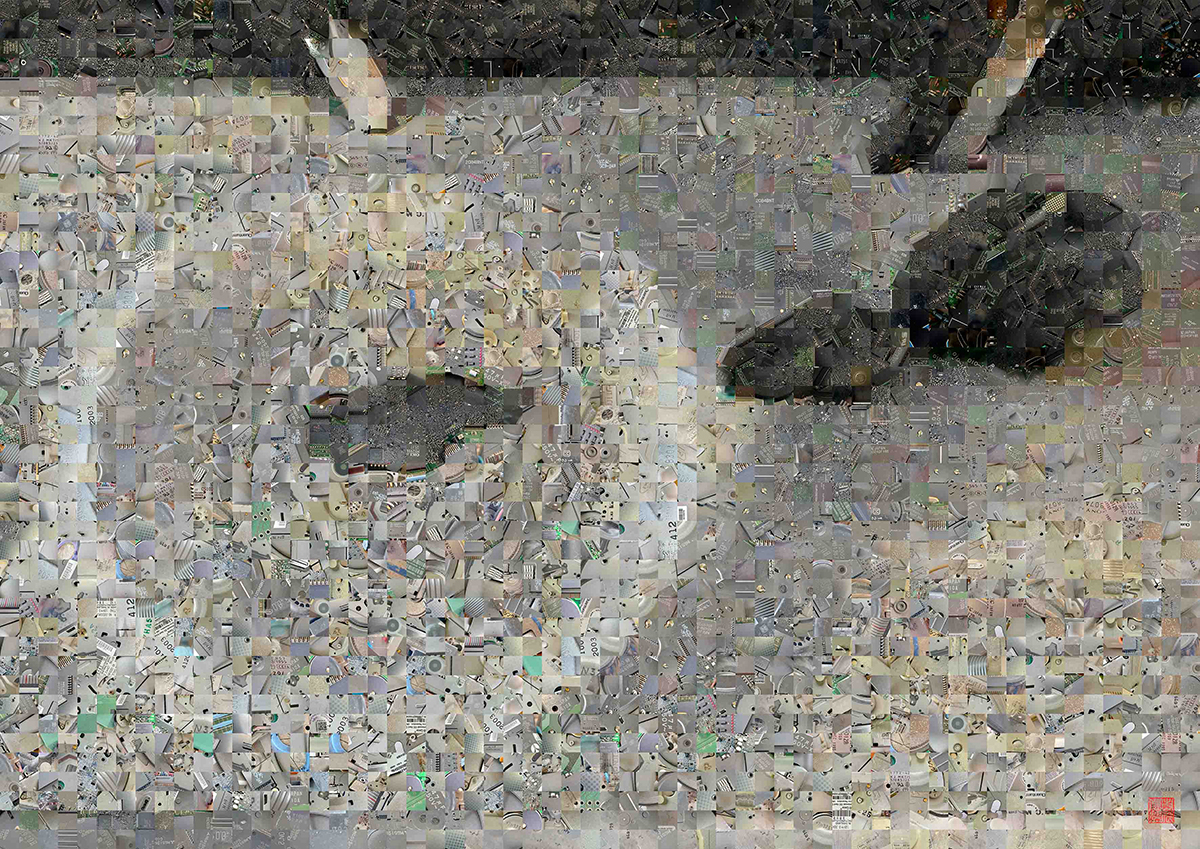
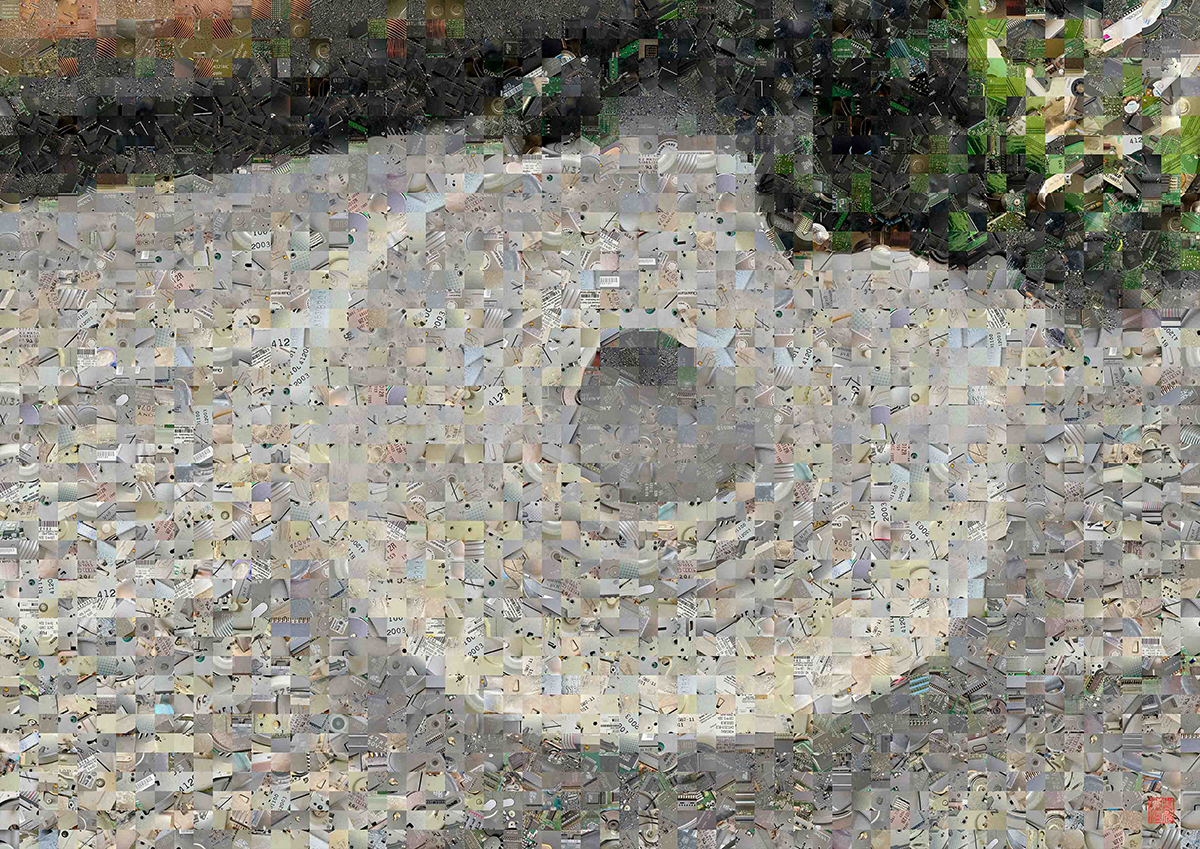
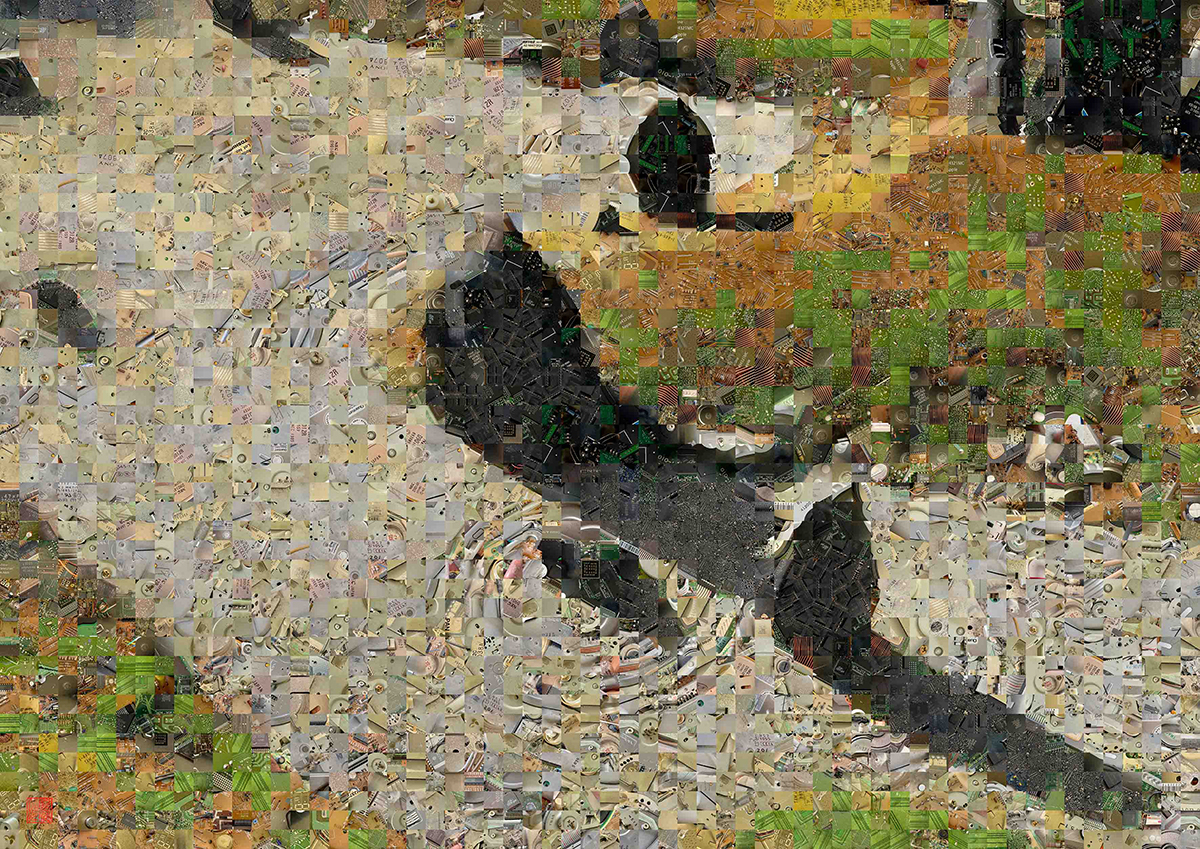
The ZEN Garden series reinterprets Zen gardens through the structural language of electronic circuitry. Ichikawa personally photographs countless circuit boards and combines those images with his own photographs of Zen gardens in Kyoto, reconstructing them through his original technique, “Pixel Montage.”
Though belonging to different realms, Zen gardens and electronic circuits share a profound structural affinity. Both are systems composed of innumerable interconnected elements that form a unified and functional whole. The rhythmic patterns of wiring recall raked sand; circuit pathways echo stone arrangements. From close range, intricate details emerge; from a distance, a quiet harmony appears.
By layering and reconstructing fragments of technology and nature, the work reveals a shared order underlying both. The accumulation of microscopic components gradually generates a macroscopic landscape, where stillness is presented not as emptiness, but as a structured equilibrium shaped by repetition, balance, and subtle variation.
By incorporating images of circuitry he has personally captured, Ichikawa emphasizes the invisible systems that organize both technological and natural environments. What appears mechanical begins to resonate with organic rhythm. Through this parallel, photography becomes a means of visualizing hidden architectures—where spirituality and functional design converge within a single contemplative landscape.

professional category
Zen Garden – The Structure of Silence (Series)
DESCRIPTION
AUTHOR
Kenji Ichikawa is a Japanese contemporary artist and photographer born in Nagano in 1967.
He received his MFA from Musashino Art University in 1997 and developed his original technique,
“Pixel Montage,” in 1988. By meticulously cutting and reconstructing photographs into mosaic-like structures, he creates images that move between microscopic detail and macroscopic perception, reflecting on memory, vision, and contemporary image culture.
In recent years, he has focused on the series ZEN CITY and ZEN GARDEN, exploring the structural affinities between electronic circuits and Japanese gardens. Working across digital and analog forms, his layered compositions investigate density, distance, and quiet visual resonance.
His work has been exhibited internationally, including in Venice, Shanghai, and Germany.
He was a finalist of the 19th Arte Laguna Prize (2024) and the Homiens Art Prize – Summer 2025,
and is currently exhibiting at NordArt 2025. His awards include the Taro Okamoto Memorial Contemporary Art Award (Special Prize), among others.
Through fragmentation and reconstruction, Ichikawa redefines photography as a contemplative structure rather than a captured moment, proposing an alternative vision of stillness within contemporary visual culture.
He received his MFA from Musashino Art University in 1997 and developed his original technique,
“Pixel Montage,” in 1988. By meticulously cutting and reconstructing photographs into mosaic-like structures, he creates images that move between microscopic detail and macroscopic perception, reflecting on memory, vision, and contemporary image culture.
In recent years, he has focused on the series ZEN CITY and ZEN GARDEN, exploring the structural affinities between electronic circuits and Japanese gardens. Working across digital and analog forms, his layered compositions investigate density, distance, and quiet visual resonance.
His work has been exhibited internationally, including in Venice, Shanghai, and Germany.
He was a finalist of the 19th Arte Laguna Prize (2024) and the Homiens Art Prize – Summer 2025,
and is currently exhibiting at NordArt 2025. His awards include the Taro Okamoto Memorial Contemporary Art Award (Special Prize), among others.
Through fragmentation and reconstruction, Ichikawa redefines photography as a contemplative structure rather than a captured moment, proposing an alternative vision of stillness within contemporary visual culture.
back to gallery